ERP Implementation Timeline: What to Expect
When businesses plan an ERP implementation, they usually focus on the technical timeline:
Requirements. Configuration. Testing. Data migration. Go-live.
But there is another timeline running alongside it:
The people timeline.
Employees need to understand what is changing, why it is changing, how their daily work will be affected, and how to use the new system confidently.
Ignoring this side of the project is one of the reasons ERP adoption becomes difficult.
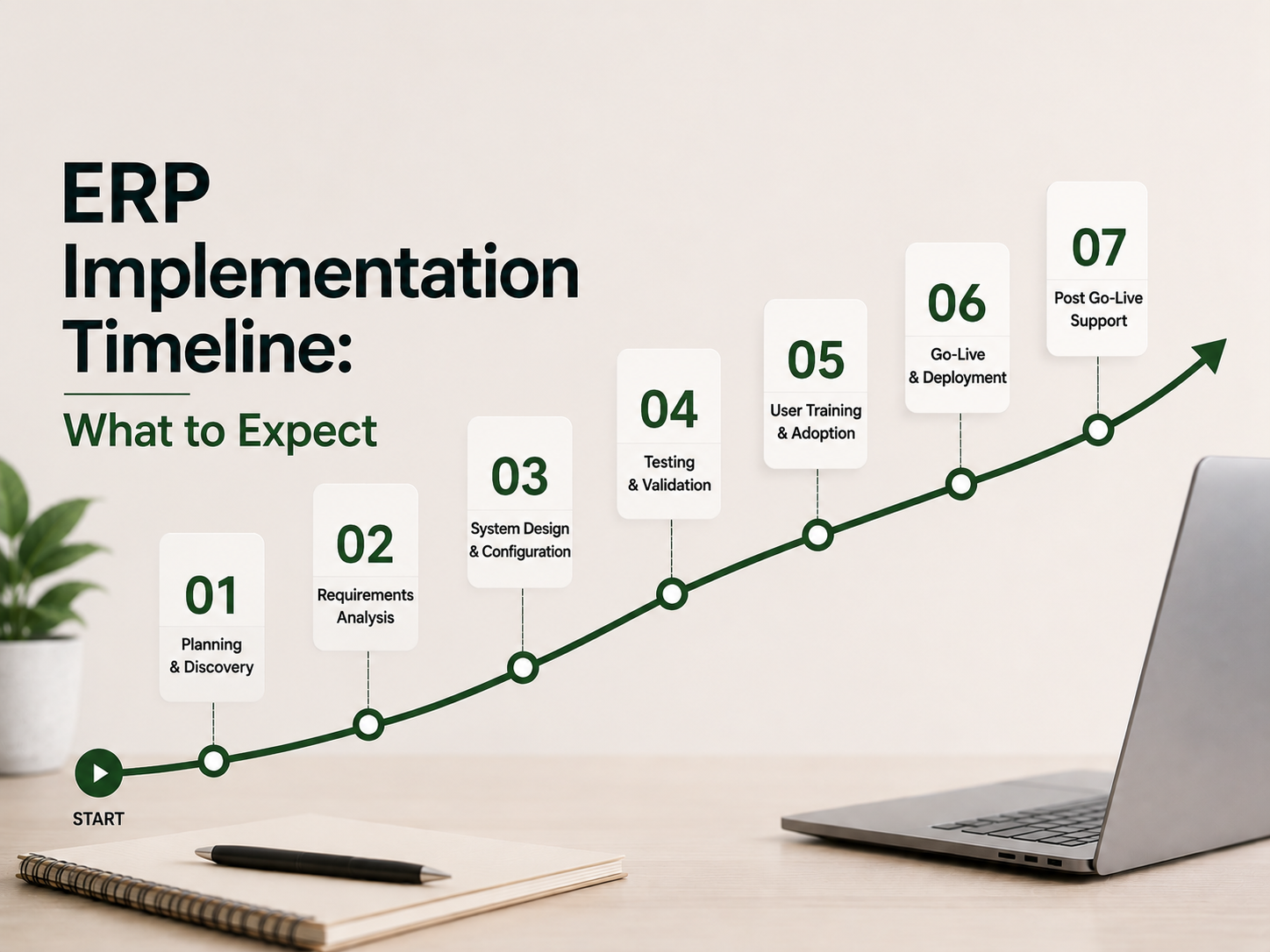
Here is what businesses should expect throughout an ERP implementation.
Phase 1: Project Kickoff — Create Awareness
At the beginning, employees may have many questions:
Why are we changing the system?
Will my process change?
Will my role be affected?
Management should communicate the purpose of the ERP project early.
Employees are more likely to support change when they understand the business problem being solved not simply that management has purchased new software.
Phase 2: Requirements — Involve the Right Users
ERP requirements should not be defined only by management or the implementation partner.
The employees who perform daily activities often understand operational problems better than anyone else.
Key users from finance, sales, purchasing, inventory, operations, and other departments should participate in requirement gathering and process mapping.
People support systems they helped shape.
Phase 3: Configuration — Prepare Users for Change
As the ERP takes shape, businesses should identify how existing roles and processes will change.
A five-step manual approval may become a digital workflow.
A spreadsheet may disappear.
A report that previously took hours could become a dashboard.
Employees should understand these changes before go-live not discover them on the first day of using the ERP.
Phase 4: Testing — Let Users Experience the New Process
User Acceptance Testing (UAT) is more than checking whether the software works.
It allows employees to experience how their real business processes will work in the new ERP.
Users should test realistic scenarios and provide feedback.
This helps identify both system problems and adoption problems before go-live.
Phase 5: Training — Build Confidence
Generic ERP training is rarely enough.
Employees need role-based training.
A warehouse user does not need the same training as a finance manager. A sales executive does not need to understand every accounting configuration.
Training should focus on:
“What do I need to do in the ERP to perform my job?”
The objective is not simply to complete training. It is to make users confident enough to work independently.
Phase 6: Go-Live — Expect a Learning Curve
Go-live is an important milestone, but employees will not become ERP experts overnight.
Questions, mistakes, and uncertainty during the first few days are normal.
Management and the implementation team should provide quick support while closely monitoring whether employees are following the new processes.
Avoid allowing old spreadsheets and manual processes to quietly become the default again.
Phase 7: Hypercare — Turn Usage into Adoption
After go-live, the focus should move from implementation to adoption.
Which users are struggling?
Which processes are being avoided?
Where are employees creating workarounds?
Which workflows need improvement?
These questions help distinguish between an ERP that is simply live and an ERP that is actually adopted by the organization.
Your ERP Timeline Is Also a Change Management Timeline
ERP implementation is not simply about configuring software and reaching a go-live date.
At every stage, people need to move with the project:
Awareness → Involvement → Preparation → Testing → Training → Adoption
Technology can be ready while the organization is not.
That is why successful ERP projects plan for people, processes, and technology together.
At LABOFWEB , we approach ERP implementation with this wider perspective—from requirement gathering and process mapping to user readiness, go-live, and post-implementation support.
Planning an ERP implementation? Talk to LABOFWEB about building an ERP roadmap that prepares both your system and your people for change.
Ready to Elevate Your Digital Operations?
Whether you need custom ERP solutions, web & mobile applications, or sustainability management, our expert team is here to help you scale efficiently.